
The warehouse of 2026 looks fundamentally different from the warehouse of 2015. What was once a manually intensive environment — clipboards, paper pick lists, periodic stocktakes — is being transformed by a convergence of technologies: artificial intelligence, automation, IoT sensors, and real-time data infrastructure.
For warehouse operators and supply chain leaders, this transformation is not a distant threat or a speculative opportunity. It is happening in competitive operations right now. The organisations adopting these technologies are reducing costs, improving service levels, and scaling capacity without proportional increases in headcount.
This guide explains what smart warehousing means in practical terms, which technologies are delivering value today, and where the trajectory is heading.
What Is a Smart Warehouse?
A smart warehouse is not defined by the presence of robots or any single technology. It is defined by the depth of visibility, the degree of automation, and the quality of data-driven decision-making across the operation.
The key characteristics of a smart warehouse:
- Real-time inventory visibility at the bin and unit level
- AI-powered demand forecasting and inventory optimisation
- Directed workflows that minimise human decision-making at the point of activity
- Automated or semi-automated physical handling of goods
- Continuous data collection from IoT sensors, scanners, and connected systems
- Integration with upstream supply chain systems (ERP, procurement, supplier portals) and downstream logistics
Not all of these capabilities need to be present to qualify as 'smart.' Most operations adopt smart warehouse capabilities progressively — starting with visibility and directed workflows, then adding automation and AI as operational maturity grows.
AI and Machine Learning in Warehouse Management
Artificial intelligence in warehousing is not about robots — it is primarily about making better decisions faster. AI analyses patterns in operational data that would be invisible to human analysts and uses them to optimise decisions in real time.
Demand Forecasting and Inventory Optimisation
Traditional inventory management relies on fixed reorder points and safety stock rules that are set once and rarely reviewed. AI-powered forecasting analyses sales velocity, seasonal patterns, supplier lead times, and external signals — such as promotional calendars and market trends — to dynamically adjust reorder quantities and timing.
The result is a warehouse that carries less stock overall while experiencing fewer stockouts. For operations with thousands of SKUs, the working capital savings from AI-optimised inventory levels typically run into hundreds of thousands of pounds annually.
Intelligent Bin Placement
Warewiser's AI-powered bin recommendation engine analyses velocity, SKU relationships, weight, and spatial constraints to recommend the optimal storage location for every item — and to identify when existing placements should be rearranged as demand patterns shift.
This is one of the highest-value AI applications in warehousing because bin placement has a compounding effect: every item stored in the right location reduces pick travel time for every future pick of that item. Across thousands of picks per day, the accumulated time saving is substantial.
Anomaly Detection and Predictive Alerts
AI monitors operational metrics continuously and surfaces anomalies before they become problems. A location with unusual stock movement patterns is flagged for cycle counting. An SKU with unexpected velocity reduction might indicate a quality issue or a competitor shift. A dock door processing more units than usual might indicate a scanning error or an unrecorded receipt.
These predictive alerts direct management attention to where it is actually needed, rather than requiring supervisors to discover problems through observation or customer complaints.
Automation: From Assisted to Autonomous
Automation in warehousing exists on a spectrum. At one end is software-directed automation — where a WMS directs human operators through optimised workflows. At the other end is fully autonomous operation — where robotic systems move, sort, and store goods with minimal human involvement.
Autonomous Mobile Robots and AGVs
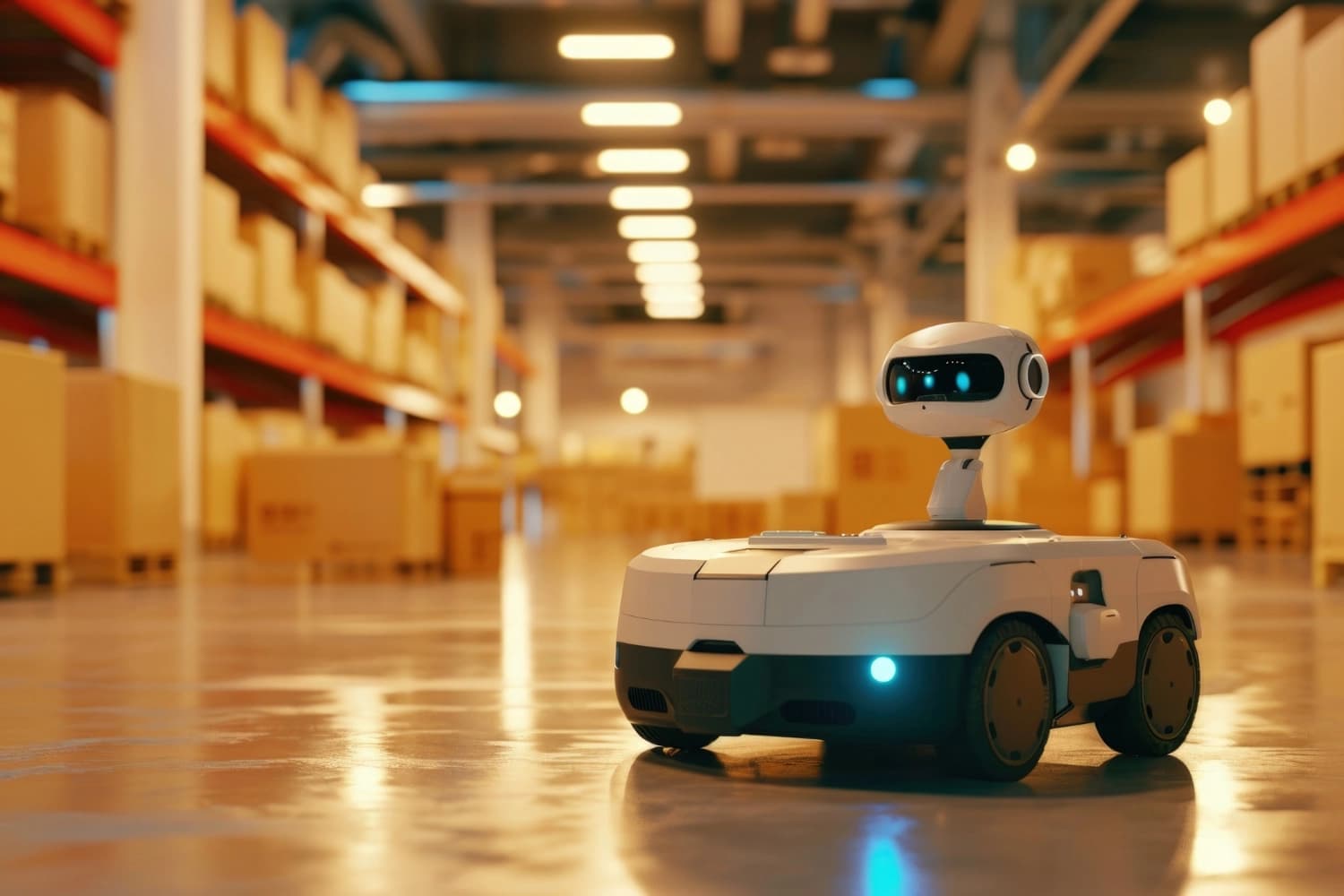
Autonomous Mobile Robots (AMRs) and Automated Guided Vehicles (AGVs) are now common in medium-to-large distribution centres. AMRs navigate dynamically using onboard sensors and can work alongside human operators without fixed track infrastructure. They are typically deployed for goods-to-person picking — where the robot brings shelving units to a stationary picker — and for intra-warehouse transport.
AMRs integrate with WMS platforms through APIs, receiving task assignments from the warehouse management system and reporting completion in real time. This integration is essential — a robot without a WMS connection is just expensive hardware.
Automated Storage and Retrieval Systems
Automated Storage and Retrieval Systems (AS/RS) use automated cranes or shuttles to store and retrieve goods from high-density racking. They are most common in cold chain environments, pharmaceutical facilities, and high-SKU-count operations where maximising storage density within a constrained footprint is critical.
AS/RS systems typically deliver 3–6x the storage density of conventional racking and near-perfect picking accuracy, at the cost of significant capital investment and less flexibility to accommodate product mix changes.
Real-Time Visibility: The Foundation of Everything
Every form of warehouse intelligence — AI forecasting, automated robotics, predictive alerts — depends on real-time data as its foundation. A warehouse without real-time visibility cannot be effectively automated or intelligently managed, regardless of how sophisticated the surrounding technology is.
Real-time visibility in the smart warehouse means:
- Every stock position known at the bin level in real time
- Every goods movement recorded at the point of activity via scanner or sensor
- Every inbound and outbound shipment tracked from departure to receipt
- Labour activity visible in real time across all zones and teams
- System-to-system data synchronisation with ERP, transport management, and carrier systems
Warewiser delivers this foundation through its core WMS platform — and builds AI and analytics capabilities on top of the real-time data layer it creates.
The Role of IoT and Sensor Networks
The Internet of Things is expanding the data available to warehouse management systems beyond what scanners alone can provide. Temperature sensors monitor cold chain compliance continuously. Weight sensors on racking monitor load and can detect movement without scanning. Environmental sensors track humidity, air quality, and lighting conditions.
As sensor hardware becomes cheaper and more reliable, the data infrastructure available to AI systems becomes richer. A WMS that can ingest and act on IoT data alongside scan data and ERP data becomes a genuinely intelligent operational platform — not just a sophisticated task management system.
The Competitive Imperative
Smart warehousing is not a luxury for organisations with unlimited budgets. It is an operational imperative for any business that competes on fulfilment speed, inventory accuracy, or operational cost.
The entry point to smart warehousing is not a robotic fleet or an AS/RS installation — it is a modern WMS that delivers real-time visibility and directed workflows. From that foundation, AI, automation, and IoT capabilities can be added progressively as the operation grows and the data matures.
Warewiser is designed to be the intelligent foundation your warehouse operation needs today — and to grow with you as you adopt more advanced automation and AI capabilities tomorrow. Getting started takes 48 hours, not 18 months.
The organisations investing in smart warehouse capabilities today are not just improving efficiency — they are building competitive advantages that will compound as the technology matures and the performance gap between intelligent and manual operations widens.